
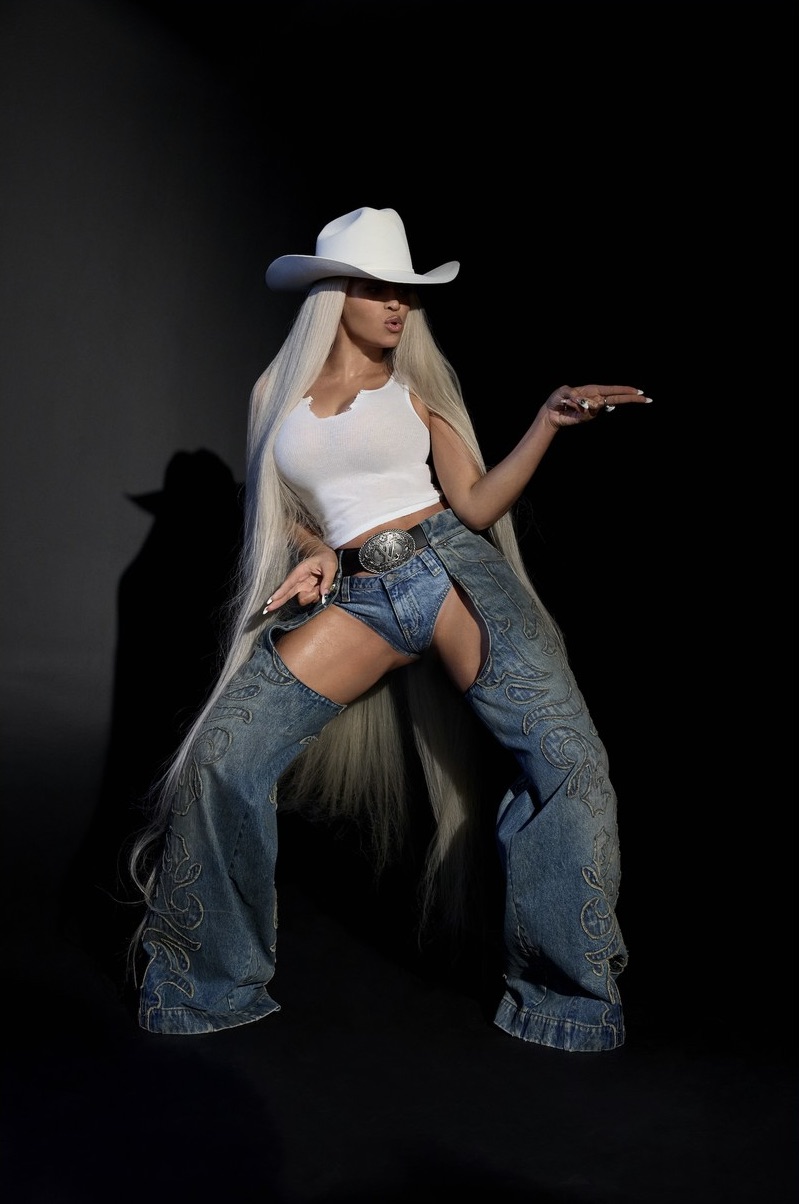
Beyoncé’s eighth album “COWBOY CARTER” makes clear that the Houston-born diva is just about as country as they come. Far from a simple country album, the record is an expansive demonstration of the singer’s cultural and musical knowledge as told through genre-bending songs that shake, croon, thump and bounce with a twangy wink.
While the music itself on “COWBOY CARTER” isn’t entirely political, Beyoncé’s reclamation of her country roots speaks to a broader context of Black musicians as they relate to musical genres. Whether making pop, country, alternative or any kind of music, Black musicians, and the Black identity as a whole, are often seen as inherently political forces that the white mainstream attempts to place into boxes where they see fit. The work of many contemporary country and folk artists (Brittany Spencer, Kara Jackson and Mickey Guyton, among many more) revitalizes the roots of the genre and redefines what the faces of these styles can look like. Black performers in country music are not strictly vessels for political messages, but by virtue of the history of the genre, their work gains an added, politically infused context.
“If I ain’t country tell me what is,” the singer belts out on album opener “AMERIICAN REQUIIEM.” (The use of “I” appears on physical copies of the record while “that” is used on streaming platforms. For all intents and purposes, “I” befits Beyoncé’s message best.) The opening track references the album’s core intent, which is that its creation was born out of the racially-charged criticism Beyoncé faced after performing her song “Daddy Lessons” at the 2016 CMAs with The Chicks. “It’s a lot of talkin’ goin’ on/While I sing my song,” she drawls, commanding the listener’s attention while also directly referencing her disparagers.
Born and raised in Houston, Beyoncé has always been proud of her country background. As she quite literally spelled it out in 2016’s “Formation”: “My daddy Alabama, momma Louisiana.” Whether it be her western-chic style (which traces back to her Destiny’s Child days) or her music (take “Daddy Lessons” off of “Lemonade,” for example), the singer has always referenced her familial roots of the south both visually and sonically. Her latest album follows 2022’s masterclass of house and dance liberation “RENAISSANCE,” which gave a global spotlight to the Black and brown queer artists who founded the musical genres. For the second act of her trilogy of albums, the singer shines a similar light, this time on the origins and evolution of country music.
What becomes clear after just one listen is that while “COWBOY CARTER” has a country-mindedness at its core, it’s really not an exclusively “country” album. Roughly the first half of the LP is filled with songs that sound most like how many think of the genre. “BLACKBIIRD” gives new life to The Beatles’ 1968 song about racism and the American Civil Rights Movement while “16 CARRIAGES” details the singer’s coming of age in the music industry and her parent’s divorce over the clang of boisterous drums and acoustic guitar. Tender tales of motherhood (“PROTECTOR”), smooth anecdotes of infatuation (“BODYGUARD”) and jumpy anthems for the Lone Star State (“TEXAS HOLD ‘EM”) flow from one to the next. Everything from guitar to banjo, organ to sitar are heard during the first half of the album, in effect creating a full-bodied sound that feels authentically country backed by Beyoncé’s seasoned voice.
As the singer said in an Instagram post prior to the album’s release, “this ain’t a Country album. This is a ‘Beyoncé’ album.” As she makes her way through all 27 songs, her country focus begins to vary and incorporate cross-genre influences.
The concept of musical genres is first directly mentioned on “SPAGETTII,” a hip-hop-inspired cut built on a Brazilian funk sample. The song opens with a spoken intro voiced by Linda Martell, who became the first Black solo female artist to play the Grand Ole Opry in 1969. “Genres are a funny little concept, aren’t they?” Martell asks. “In theory, they have a simple definition that’s easy to understand/But in practice, well, some may feel confined.”
Beyoncé’s inclusion of Martell directly acknowledges the history of Black performers being excluded from country music. Martell’s career in country music was cut short after she faced intense racism and a series of record label conflicts, ultimately neglected from the genre and industry and large. In addition to Martell, Chuck Berry, Sister Rosetta Tharpe and Son House are sampled on the album. Tharpe’s work, for example, was one of the sources of inspiration for Elvis Presley’s musical style but has been largely sidelined from the musical history she was an integral part of. These contributions to the album does more than simply give a shoutout to historical figures, but rather highlights the underrepresented Black musicians who were instrumental in the origins of what country was and has become.
Showcasing the historically underrepresented voices of country music bears added relevance in a post-2020 world. The amount of Black musicians finding success in the country and folk genres has slowly but surely increased in recent years. Kara Jackson’s poetic, diary-like songs, Mickey Guyton’s power ballads and Brittany Spencer’s sweeping melodies are not inherently declarations of genre repossession, but represent space being made in a field where space has unjustly been kept out of reach.
Through the music that these Black mucisians make, they can be both forces for politically-minded conversations and also just simply be entertaining country performers. Viewing every piece of work that Black musicians make as being supercharged acts of resistance is counterintuitive because it implies that Black people are inherently, and purely, political beings. Prince’s song “Sign O’ The Times” is a clear-cut representation of the singer’s dissatisfaction with the social, economic and cultural state of the late 1980’s, but it’s also just a damn good song. Janet Jackson’s “New Agenda” details racism and sexism while also delivering a luring, user-friendly groove. Nothing artistic is created or released in a vacuum, so a portion of the work by Black musicians naturally takes on a second meaning in the context of history, but it can also just be good, fun music.
Very little of the work on “COWBOY CARTER” has as explicit political prowess as, say, her unabashed anthem of Blackness, “Formation.” But by virtue of the deliberate blending of musical styles, Beyoncé’s redefinition of what contemporary country music can sound like champions her roots that many have attempted to discredit and minimize.
As Martell voices earlier in the project, “genres are a funny little concept.” The latter half of the album hosts cuts like “SWEET ★ HONEY ★ BUCKIN’,” which is far from a standard country crooner, but still proudly celebrates Beyoncé’s “sweet country home” with plenty of thumping bass and skittering percussion. “YA YA” is a masterclass of musical references, teetering into funk, rock and soul territories — once again subverting the concept of genre — for a jaunty, shaking number reminiscent of the late great Tina Turner while also sampling Nancy Sinatra’s “These Boots Are Made For Walkin’” and The Beach Boys’ “Good Vibrations.” The acrylic nail clicks on “RIIVERDANCE” harken to Dolly Parton’s “9 to 5” and blend with the bump of thick bass. Could it be a coincidence that Beyoncé incorporates musical references from white country and pop acts as a way to reference the “borrowing” that many white performers exercised in the white-washing of the genre? Maybe. But with Beyoncé, is there ever such a thing as coincidence? Even amid the endless references, samples and covers (lest one forget Beyoncé’s rendition of Parton’s “Jolene”), the album’s identity never strays too far from Beyoncé’s own distinct musical palette.
The list of specific cultural, social and historical references on “COWBOY CARTER” is endless. One could (and it’s likely that someone will) write an entire book to connect all of the dots among Beyoncé’s carefully curated storytelling. Others will simply enjoy the music for what it is at the surface — a “real life boogey and a real life hoedown.” There’s no wrong way to ingest the music. Unless, of course, that involves skipping past Queen Bey and Miley Cyrus’ astonishing duet “II MOST WANTED.” That just wouldn’t be right.
Photo by Blair Caldwell.
 Avery Heeringa