
Columbia College Chicago student Nathan Doty’s collection of eight mixed media pieces reimagines childhood memories through bold and flashy collages that utilize depth, fuzzy imagery and family heirlooms to get viewers to remember the artist’s, and their own, memories of the past.
Adolescence has been a fountain of inspiration for musicians, artists, writers and filmmakers alike for just about as long as man could put pen to paper. Throughout most of the art that’s created with references to the past at its core, change remains a constant theme. Some artists create work that depict these changes in all of their often uncomfortable processes (like the 2016 film, “The Edge of Seventeen”), and others create as a way to honor and keep the memory of the past alive (Dolly Parton’s 1973 song “I Remember”). Change is the intangible constant that follows nearly all humans throughout life, for better or worse. When depicted or referenced in art of any kind (and when done in the right way), it holds the power to evoke more profound emotional reactions from the viewer than just a regular ol’ work about crushes or partying ‘til the sun comes up.
Doty, a current junior at Columbia studying fine art, was born and raised in the small town of Delaware, Ohio, just over 30 miles north of Columbus. From early on, the artist’s coming of age was marked with a series of major changes in his life, as well as his family’s. Upon moving to Fort Collins, Colorado around age 8, his great grandmother passed. When he was a sophomore in high school, his older brother graduated and moved out of the family home to Los Angeles, which was shortly followed by his father taking a new job and splitting time between the family home in Colorado and a place in Omaha, Nebraska. His mother visited his father often in Nebraska, often leaving Doty living alone for the remainder of high school in the downsized apartment he shared with his mom.
Last October Doty’s maternal grandmother Loretta passed, leaving a hole in the young artist’s family. His visit to Ohio last fall, where Loretta lived up until her passing, was the first time he’d visited the Buckeye state in half of a decade, stirring up a mix of sweet nostalgia for his childhood and a sense of disappointment in things not feeling the way they had when he was younger. Early this year he began putting pencil to paper, aiming to capture his memories of living in Ohio during what he called his “formative years.”
“I think I wanted to make this work as a way of preserving the memories I had there at the time,” Doty said. “I have really great memories of Ohio, but that’s not necessarily how I view it now. After spending some time there, I wanted to preserve those feelings.”
Few people can likely recall an extensive amount of vivid memories from ages 1-8, and even if one can, the images and feelings they revisit are typically clouded by imaginative and free-flowing childhood perception, rather than as they actually occurred. Doty seems to be an exception, or is at least conjuring up as many of those fuzzy memories for inspiration as he can.
“When you’re trying to remember specific memories from your childhood, there’s always imagery that is in your head of what that memory is. But you’re never going to fully remember the memory as it actually happened,” he said. “Whatever first came to mind is what I put to paper because I kind of wanted to explore the idea of an incomplete memory.”
After first sketching out pieces of furniture, neon signs, a troll’s head from the “Harry Potter” franchise, Doty digitally scanned his sketches into his computer and began manipulating the images to fit the fuzzy distortion of his childhood memories and find their place in collages.

He cited the forward in Patti Smith’s 2010 memoir “Just Kids” as an inspiration for capturing the memories he has of Ohio. “Swan, my mother said, sensing my excitement,” Smith writes. “The word alone hardly attested to its magnificence nor conveyed the emotion it produced. The sight of it generated an urge I had no words for, a desire to speak of the swan, to say something of its whiteness, the explosive nature of its movement, and the slow beating of its wings.” This incessant need to capture moments in one’s life or the things that one finds beautiful struck Doty as a familiar feeling, and launched himself into the creative process.
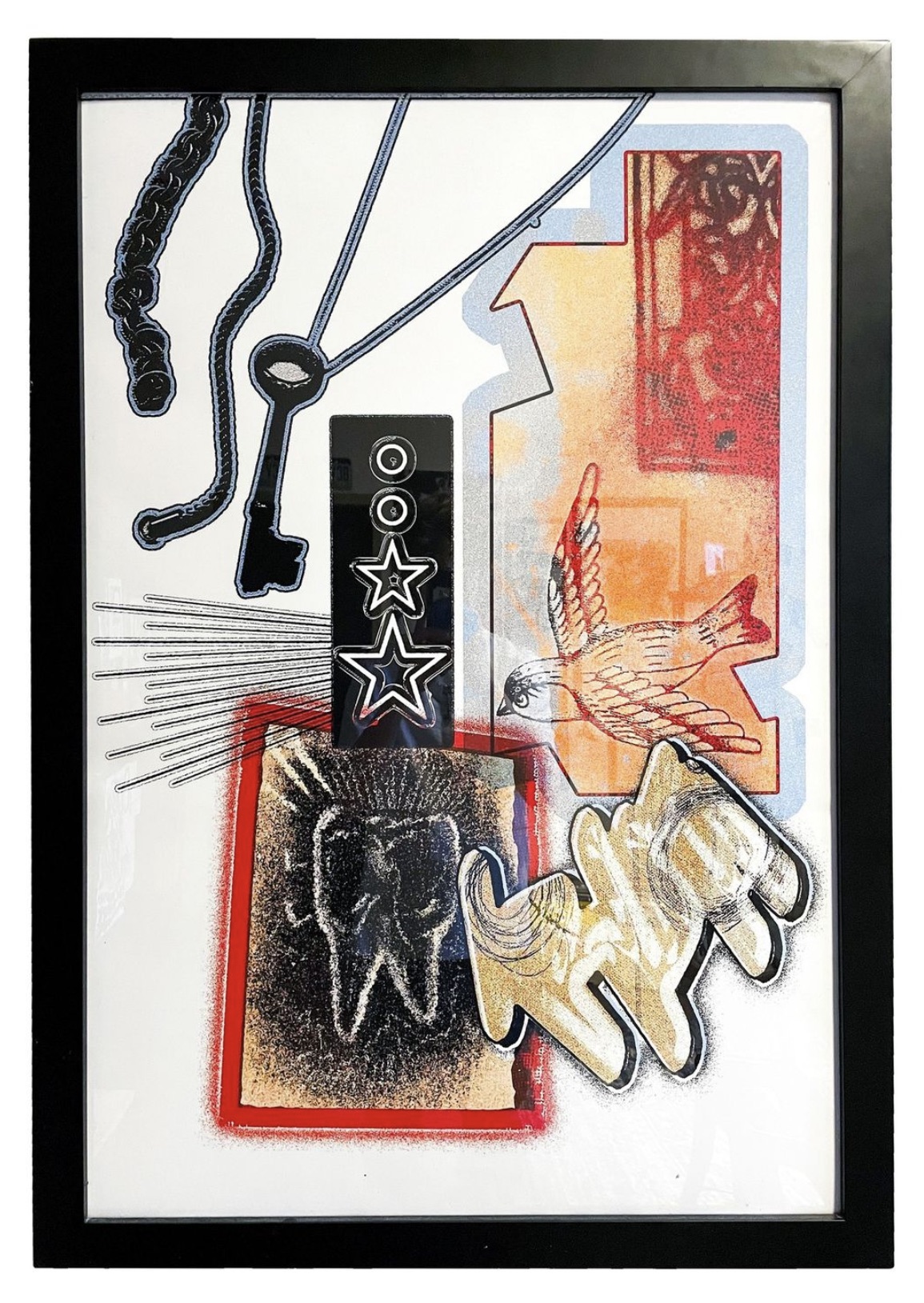
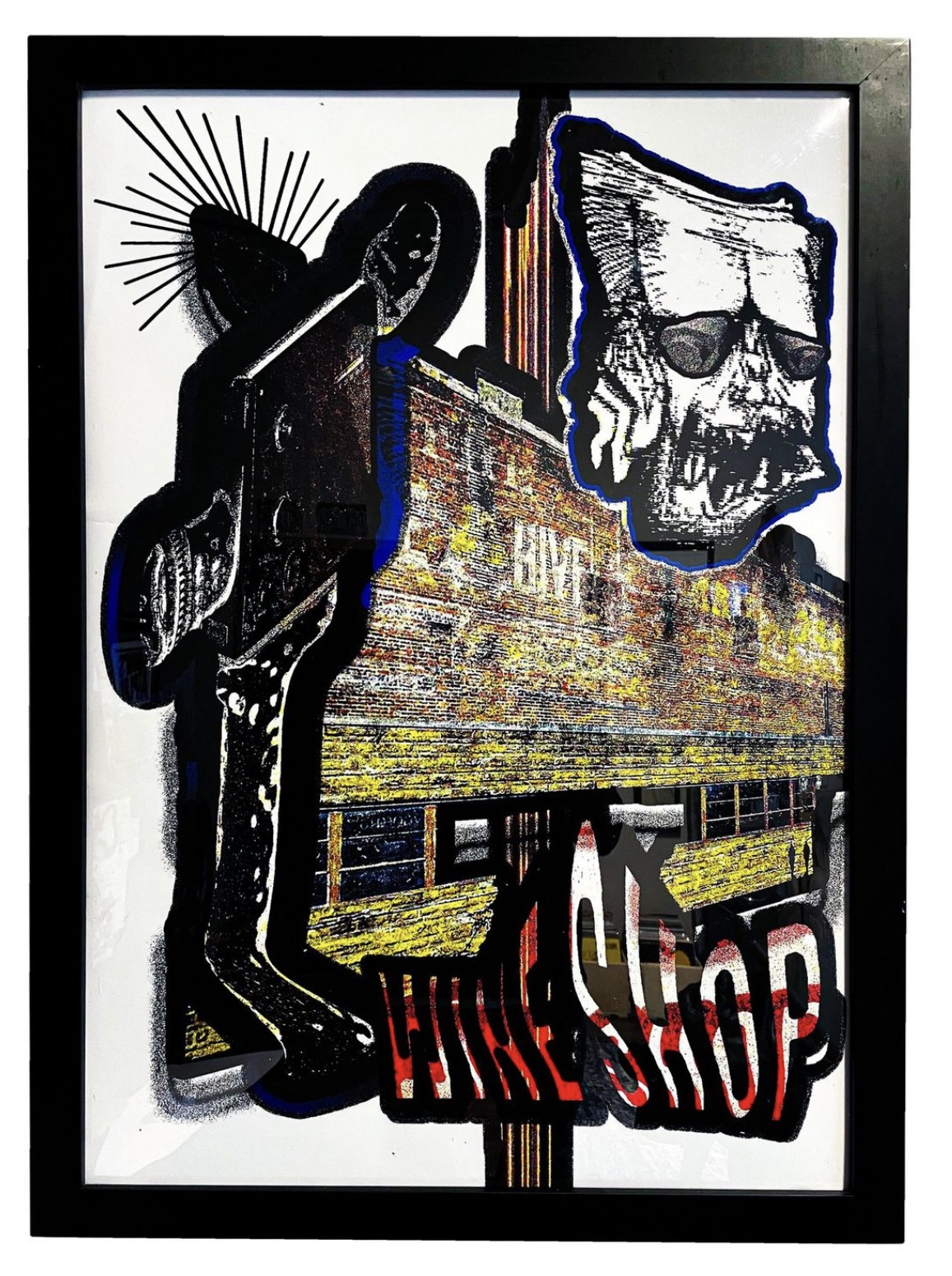
The collection includes mixed media collage pieces that combine photography and physical drawings, then distorting them in Photoshop and Illustrator. The full collection, currently standing at eight pieces, features images of a toy sword hovering above a glowing television set to jewelry dangling over sketches of bird tattoo designs and teeth.
One piece titled “Milk Glass” features drawings of vases made of the opaque glass material contrasted with a dark sketch of a zebra’s head and a drawing of the deranged-looking eye featured on the single art for the Red Hot Chili Peppers’ 1999 single “Scar Tissue.” The white vases at the forefront of the piece reference similar china that could be found all around grandma Loretta’s home. The arched phrase “saudade” (a Portuguese word that defines a “feeling of longing, melancholy, or nostalgia”) curves along the vases rounded edges, giving indication to the piece’s intended meaning.
Among the full collection, two pieces titled “Cowboy Killers” and “Recurring Dream” capture the warped and dizzying nature of revisiting one’s memory bank best.

“Cowboy Killers,” the piece that started the full collection, incorporates a warped western-looking neon cowboy sign alongside a misty vignette of a sunset, dreary-looking winged haloed figure and a flurry of stars reminiscent of those that would float around a certain tomcat’s head after a violent encounter with a certain spirited mouse. Together, the elements combine to create a vivid and hazy warm-toned collage that represents learning of a nuanced situation involving the artist’s maternal side of the family.
Doty described the images and figures as vessels for expressing the complicated story involving his grandparents. Despite the fact that he was not yet born when the situation unfolded, the artist creatively expressed his bonds with the family members involved, now informed by the deeper knowledge.
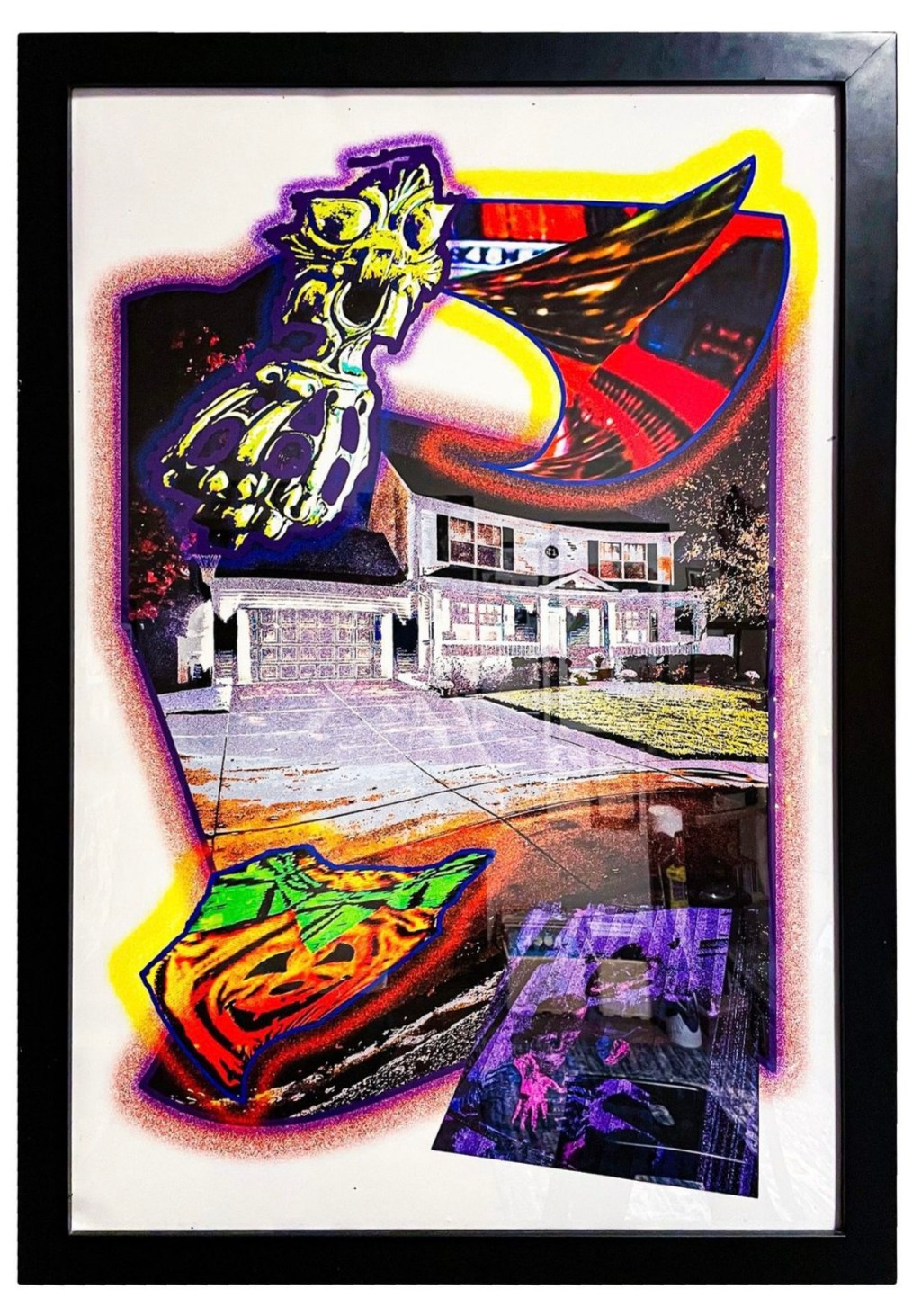
“Recurring Dream” is without a doubt the star of the collection for its nightmarish warping of images and use of deep colors. Inspired by a particularly memorable Halloween, around when Doty was 6 years old, the piece is named after a consistent nightmare he had involving a giant psycho clown running after him in his neighborhood — which was born out of a neighbor dressing up as that same clown on stilts and seeming “taller than the house itself,” as Doty described.
In the center of 24” by 36” print, a photo of Doty’s childhood home in Ohio — a sturdy, white Colonial-style house with a Farmhouse-inspired wrap around porch — centers itself in between stretched out images of jack-o-lanterns and a photo of Doty and his older brother. The collage’s edges are fuzzed-out atop a stark white background (which shows up in almost all of the collection), almost looking like a giant sticker one could peel off of a waxy backing sheet. The harsh contrast between the saturated symbols, photos and drawings on the page and the crisp, blank backdrop allow for a heightened visual interest. Rather than appearing unfinished or as if he forgot to color in the background, the contrast adds to the visual weight and significance of the work, adding a sense of containment for viewers to know where exactly to look for meaning.
“If you saw a [painting by Claude] Monét, and it’s like lily pads, like, that’s cool, it’s lily pads and it’s beautiful, but I’m not thinking about anything other than lily pads right now,” Doty said. “I like the idea of using simplistic imagery that makes you think about more than what you’re actually seeing.”
Beyond adding an engaging sense of contrast, the dark vignette of Doty’s home against the bright background practically resembles a portal straight into the artist’s interpretation of the depicted Halloween night. The image takes up nearly the full frame of the piece, and is angled in a way that makes the house appear just within reach beyond the thin paper between the viewer and the house itself.
Doty’s practice of picking out figures, iconography and images that resonated with him in his adolescence are at times acutely literal, like the photo of his home in “Recurring Dream” and the image-turned-drawing of the neon cowboy sign in “Cowboy Killers.” Other times, he uses family figures and objects as starting points for intense distortion and reimagining. The dreary haloed figure in “Cowboy Killers” is meant to represent his grandpa Rick’s current wife, and the sketch of a tooth in “Self 2,” situated underneath drawings of dangling jewelry, represents the skeletal decor that his family kept on display year-round in their home.
“Some of these symbolic visuals that I’m using, they’re kind of more interpretive and abstract than what I would normally do,” Doty said. “They’re not super literal. Some of them are, but some of them aren’t, just because I like the idea of messing around with visuals that I don’t necessarily fully remember but in my mind I have a clear image of what it is.”
There’s a universal quality of selecting key moments and experiences from the past and choosing to either romanticize and preserve the memories, or grapple with the reality of the memories without rose colored glasses. Practically all art forms share this practice at their core, because what is creative inspiration without drawing upon life lived?
In the 2016 movie “The Edge of Seventeen,” protagonist Nadine (Hailee Steinfeld, “Pitch Perfect 2”) tracks the major changes in her oftentimes dull suburban life with astute pessimism, choosing to view the friendship fallouts, loss of her father and monotony of high school with a bitter, cynical attitude. The shit that happens to her is pretty miserable (losing a parent to a heart attack and later falling out with her best friend is no walk in the park), and her understandably negative response to these life changes preserves her future memories of being a 17-year-old in the suburbs of Portland as being just as gloomy as they feel in the moment.

Alternatively, take the 1997 comedy film “Romy and Michele’s High School Reunion” for example. Before any naysayers of the lighthearted and at-times outlandish story of friendship and redemption shoo away its relevance, consider the character Michele’s (Lisa Kudrow, “Friends”) words to her on-screen best friend Romy (Mira Sorvino, “Mighty Aphrodite”). In the film, the pair of friends attend their 10 year high school reunion, only to realize that they’ve accomplished little to nothing in the time since graduation — and en route to the reunion, they revisit countless memories which make them realize that high school wasn’t as glamorous as they’d remembered. “I never knew that we weren’t that great in high school,” Michele says to Romy. “I mean, we always had so much fun together, I thought high school was a blast. And until you told me that our lives weren’t good enough, I thought everything since high school was a blast.” Kudrow’s Michele (however spacy and “blonde” she may be) chooses to remember only the good of the past, and preserves her memories with a rose-colored tint.
The 2004 film “Eternal Sunshine of the Spotless Mind” follows the story of Clementine (Kate Winslet, “Titanic”), who endures a procedure to erase memories of her ex-boyfriend Joel (Jim Carrey, “The Mask”) as a way to avoid the painful reminders of the relationships end. The plot of “Eternal Sunshine” is essentially opposite from Doty’s act of memory preservation, but both detail grappling with choosing how and if one wants to remember their past.
Music could be considered the art form most commonly created with an air of reminiscence involved, whether sweet or bitter. Country legend Dolly Parton’s 1973 song “I Remember” boasts choosing to recall the “meadows and fields of golden wheat” and “song birds and sugar cane so sweet” from her youth, despite Parton’s self-described “dirt poor” upbringing in a one-room home with 11 siblings. The Smashing Pumpkins’ (one of the bands Doty grew up listening to) 1995 song “1979” finds the lead singer Billy Corgan struggling to “shake these zipper blues” after a life of constant change and moving around. Fleetwood Mac’s 1975 song “Landslide” details being “afraid of changin’” and “getting older too.” Stevie Nicks uses the metaphor of seeing her “reflection in the snow-covered hills” as a reason to let a “landslide bring it down,” out of worry that she may be reflecting too much, allowing herself to be stuck in the past. The musical examples go on and on.
Among all reflections of one’s own past, there’s always a fine line between healthy introspection and destructive over-analyzing. When one begins to let the snowball of reminiscence grow bigger and bigger, they run the risk of being trapped in their considerations of the past. Art that is created with the intention to touch upon these themes of sentimental remembrance are oftentimes far more resonant than the surface-level musings of, say, half of the pieces on display at any given modern art museum.
Though physical objects and locations informed the majority of the pieces in Doty’s collection, he said music played a role in remembering the past. The Red Hot Chili Peppers, The Smashing Pumpkins and Norah Jones are among some of the artists behind the music that soundtracked Doty’s childhood in the sleepy town of Delaware, mostly played by relatives such as his Aunt Melanie.
“The music itself might not necessarily influence the piece, but while I’ll be making a piece about that specific time or specific memory, I’ll remember a song that would be played in that memory, or remember a song I associate with that specific time,” Doty said.
Contrary to what he said, it seems that music did at times directly influence aspects of his work. How else could the evil eye from the Chili Peppers’ ”Scar Tissue” single artwork wind up in “Milk Glass?” Similarly, a ghoulish and digitally manipulated drawing of the troll from the first Harry Potter film floats in the upper right corner of the piece titled “First Friday.” Although the troll itself isn’t necessarily tied to a childhood memory or act of preserving memory (at least, one could only hope Doty wasn’t facing giant trolls in Ohio), its appearance makes clear that film characters, just like music and other non-physical media, can find their way into memories and later have an impact on creative expressions.
In revisiting his past in an effort to make peace with the loss of his grandmother, and by extension, his time spent living in Ohio. The cycle of change that marked Doty’s childhood pushed the artist to view this pattern as a normal, and even constant, occurrence. Looking back on the memories of grandma Loretta may be marked with a keen sense of sorrow, but Doty uses intentional (and impactful) creative reminiscence on his time in Ohio to define how he’d like to preserve his life there.
“That’s how I remember it, this is it. I don’t necessarily have to change that because I’m not going to go back super often anymore,” Doty said. “I’m just establishing how I want to remember it.”
*Cover photo: “Recurring Dream” | Photo courtesy of Nathan Doty.*
 Avery Heeringa